
Give AI the process, not just the data.
Most AI must infer how a business works from disconnected applications, data, documents, and logs. ViaROS starts with the complete process running in ROS.
ROS contains the process the business approved and creates the record of how every execution actually ran. Together, they provide company-specific context: what should happen, what did happen, where execution diverged, how it was handled, and whether the intended outcome was delivered. ViaROS is developing AI capabilities around this foundation.

Process gives it meaning.
Application data can tell AI what happened inside each system. It does not automatically tell AI how those actions fit together, why they matter, or what the business considers complete.
AI can search, summarize, and compare the individual records. Without the process, it must still reconstruct the operation and infer the outcome.
What system data tells AI
- The task each application performed
- The status each system recorded
- The errors each system detected
- The data each system retained
What ROS context adds
- Which actions formed one process
- What outcome the business expected
- Where the execution diverged
- Whether completion requirements were met
More data gives AI more facts. Process context tells it what those facts mean together.
A cancellation. Or a customer upgrade?
A cancellation, a credit, a new order, and an activation appear in separate systems. ROS connects these records to the approved process, giving AI context to understand what they mean together.
AI with disconnected records
Subscription
Canceled
Billing
Credit issued
Order
New plan ordered
Activation
Completed
Cancellation recorded. Meaning unclear.
These records alone do not establish whether the customer left or changed plans.
AI with ROS process context
Business intent
Upgrade the existing customer’s plan
Approved sequence
Activate the new plan before closing the old
Connected records
All four actions belong to this upgrade
Execution evidence
New plan active before the old plan closed
Customer upgraded. Still active.
The cancellation closed the old plan after the new plan was activated.

ROS creates the context AI is missing.
ROS creates operational context through execution. AI does not have to reconstruct the process after the fact or assume how the business intended it to work.
The executable process contains what the business approved.
Approved process
- Intended outcome and completion requirements
- Required sequence, decisions, and dependencies
- Participating systems, people, and data
- Defined limits, exceptions, and responses
Production record
Every production execution records what actually occurred.
- Execution identity and current state
- Actual path, actions, and timestamps
- System requests, responses, and evidence
- Divergences, corrections, and final result
Approved process + Production record = Company specific operational context
The context is not built for a single AI model. ViaROS makes it usable by the AI technologies each customer selects for the questions, analysis, and decisions it wants to support.
With this context, AI can distinguish between:
A system completing its assigned task
A process meeting its completion requirements
An error occurring and being corrected
An outcome remaining incomplete or unverified
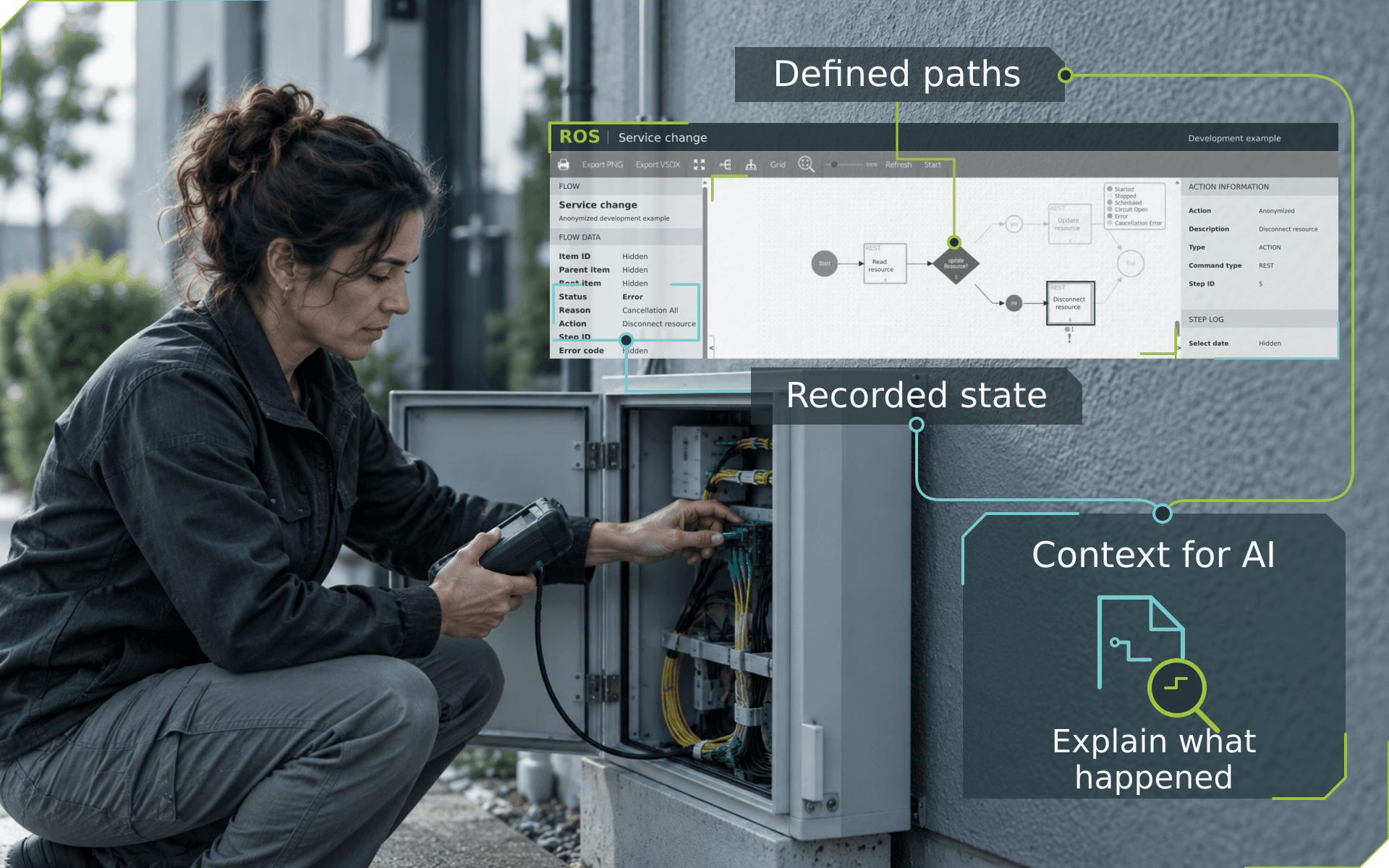
The context remains grounded in the process the business defined, not a version of the operation that AI inferred from disconnected records.
Ask the questions that matter.
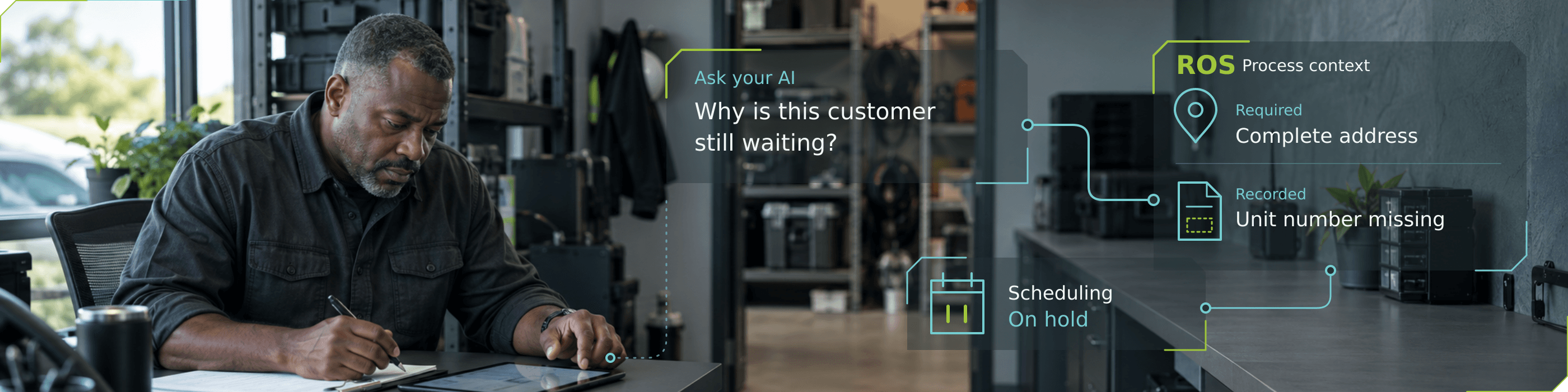
People should not have to know which application, status code, or process step to investigate. With ROS context, AI can trace the question they actually have across the complete process and its production record.
Follow one customer event across every required system and dependency.
Each answer can show the evidence behind it: the process version, path taken, system responses, state changes, corrections, and outcome status.
ROS provides the operational context; how your connected AI puts it to work depends on its capabilities, the information it can access, and what you ask it to achieve.
Ask a business question. Get an answer grounded in how the business actually ran.
More processes. Broader operational context.
One complete process provides grounded context for one business outcome. Repeated executions add evidence over time. As more of the company’s critical cross-system processes are implemented in ROS, the context available to support AI expands across the business.
01
One execution
Connect what should have happened with the actual path, supporting evidence, and final status of one event.
02
One process over time
Compare outcomes, delays, recurring conditions, and corrections across many executions.
03
Related processes
Add context around the handoffs, shared systems, data, decisions, and dependencies that connect business outcomes.
04
Broader coverage
Create an evidence-based foundation across a larger share of how the company operates and delivers value.
This expansion happens process by process. It does not give AI instant knowledge of the entire company. It creates grounded context for the complete processes ROS actually runs.
The greatest opportunity comes as the company’s critical cross-system processes become part of the same executable, traceable foundation.
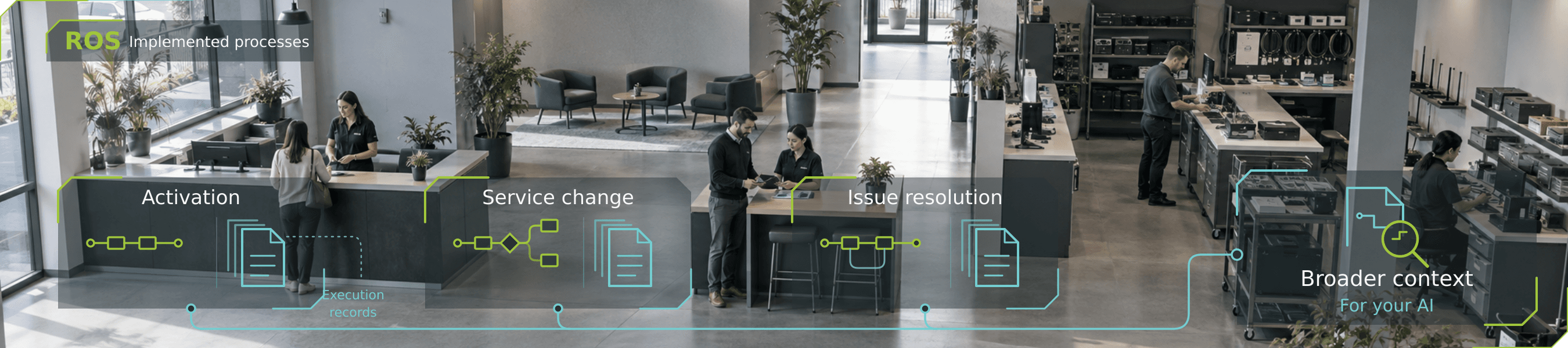
One process grounds intelligence in one outcome. Broad coverage expands the questions it can address across the business.
Build the context. Expand how intelligence can use it.
AI technologies will continue to change. The approved processes and production records created through ROS form a company-specific operational foundation that can grow as those technologies evolve.
ViaROS is pursuing two complementary paths.
ViaROS’s goal is to continuously improve how ROS-generated operational context is structured and prepared for use by the external AI models, services, and tools each customer selects for its own business goals.
The AI technology can change. The context remains grounded in the process the business approved and what production actually delivered.
The strategy continues as the foundation grows:
- Run and expand complete processes in ROS.
- Improve how their context is structured for customer-selected AI.
- Develop new ViaROS AI capabilities around the same context.
- Enrich the foundation through continued production execution.
ROS creates operational value today. Every process added and every execution recorded expands the context that can support the customer’s AI strategy over time.
What could AI help your business achieve?
Start with the questions you want answered, the decisions you want to improve, or the opportunities you want to uncover.
Explore how ViaROS can give the AI you choose a deeper understanding of your business, grounded in how it is designed to operate and what it actually delivers.